
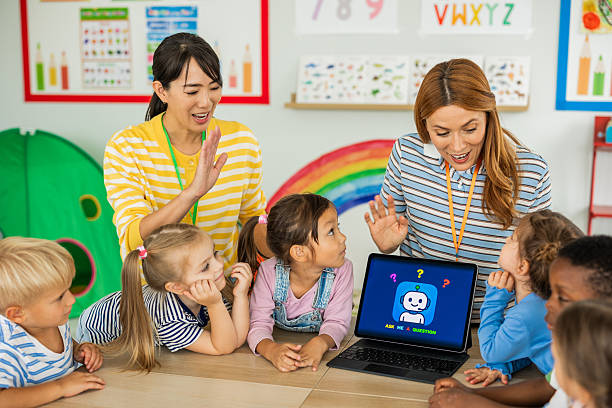

When Robots Start Teaching
So, AI tutors are everywhere now. Honestly, sometimes I wonder if my own high school math teacher could compete with ChatGPT doing algebra. You just type a question and boom — instant explanation, step by step, with no eye-rolling, no bad coffee breath, no “I’m only teaching this because I have to” vibes. It’s kinda amazing and a little terrifying.
I mean, think about it. AI doesn’t sleep, doesn’t take a personal day, and definitely doesn’t get hangry. You can have it explain fractions at 3 a.m. while eating chips in your pajamas, and it won’t judge your snack choices. That’s freedom, right?
But here’s the thing — humans, real teachers, bring… something else. Call it personality, call it empathy, call it the magic of knowing when a kid is struggling even when they say “I’m fine.” AI doesn’t really do that… yet. It’s like comparing a really smart calculator to your favorite teacher who somehow makes Shakespeare feel like a drama series.
The Pros of AI Tutors
Okay, let’s be fair. AI has some serious perks.
-
Instant feedback: Can’t remember how to solve a quadratic equation? AI will show you the steps instantly. No waiting for homework to be graded.
-
Personalized learning: It adapts to your pace. If you’re slow at one thing, it spends more time there. If you’re breezing through, it doesn’t bore you. That’s hard for human teachers in a classroom of 30 kids.
-
Cost-effective: I’ve seen some AI tutoring apps cheaper than a single session with a private tutor. And yeah, some of them are free.
And honestly, it can be fun. There’s a weird satisfaction in watching an AI “think” through a problem like it’s a mini brain doing mental gymnastics. Some online forums are full of students bragging about how their AI tutor explained calculus better than their teacher — and sometimes they’re right.
Where Humans Still Win
But let’s not crown AI king just yet. Humans have this… intuition thing going for them.
-
Emotional connection: Remember that one teacher who made you feel like you actually mattered? AI can’t replicate hugs, pep talks, or subtle encouragement. Sure, some apps try with emojis and encouraging phrases, but it’s not quite the same as someone saying, “I know you can do this” while actually looking at you.
-
Handling weird questions: AI is pretty good with facts, but throw in a question that’s vague, personal, or philosophical, and suddenly it’s like asking Siri to cook a soufflé. Humans can navigate ambiguity and creativity in ways AI struggles with.
-
Social skills and teamwork: Learning isn’t just about facts. It’s about learning how to argue politely, collaborate on projects, and survive group presentations without losing your mind. AI can’t really run a group debate — yet.
And honestly, sometimes humans are just more relatable. I remember my science teacher explaining photosynthesis like he was talking about a reality TV show. AI can’t do that — it’s stuck being… well, robotic.
Social Media Buzz: What People Are Saying
Scroll through Twitter or Reddit, and you’ll see people split 50/50 on this. Some kids are literally saying, “AI saved my life during finals week” while others are ranting, “Nothing beats my teacher who actually cares.”
There’s also a weird trend on TikTok where students share AI vs human explanations side by side. Some clips show AI giving perfect answers, but the human teacher explanation is funnier or more memorable. People love relatability over perfection — maybe a clue that AI still has some emotional catch-up to do.
And memes, oh boy. You can’t underestimate the power of memes in education. One AI tutor meme that went viral basically said: “AI doesn’t understand your existential dread at 2 a.m. while studying for physics” — funny but painfully true.
The Hybrid Future: Best of Both Worlds?
Honestly, the future probably isn’t AI replacing teachers, it’s AI helping them. Imagine a classroom where the boring repetitive stuff — spelling drills, basic math practice, fact memorization — is handled by AI, freeing up human teachers to do the cool, tricky parts: discussions, debates, hands-on experiments, real-life problem-solving.
Some schools are already experimenting with this. They use AI to grade multiple-choice stuff or provide extra practice, and teachers focus on mentorship, critical thinking, and motivation. Kind of like having a personal assistant, but for learning. I tried it once in an online coding bootcamp — AI corrected my syntax errors instantly while the instructor helped me figure out why my logic was broken. Game-changer.
It’s also worth noting that AI can give shy kids a safe space. Some students hate raising their hands in class but feel comfortable asking AI questions. That’s huge. On the flip side, it risks kids becoming socially awkward if they rely too much on AI for interaction. Balance, as always, is key.
The Niche Stuff: Stats and Facts You Might Not Know
Here’s a fun little nugget — research shows that students who use AI tutoring apps for just 15 minutes a day can improve test scores by around 10–15%. That’s not mind-blowing, but it’s not bad either. And, according to some surveys, teachers report that AI-assisted classrooms reduce grading time by up to 30%. More time for coffee breaks or explaining that one tricky concept for the hundredth time.
Also, AI is constantly learning from all students at once. It’s like the ultimate collective brain. Humans, amazing as we are, can’t remember how all 30 kids struggled last week, but AI can. That’s a pretty neat advantage if used right.
But Let’s Be Real: The Downsides
There are some shady corners too. Not all AI tutors are accurate — some give wrong explanations, especially for complex or niche subjects. And then there’s the “over-reliance” problem. If kids start thinking AI will always have the answer, they might stop trying to reason things out themselves.
Plus, privacy issues. These apps collect tons of data, and it’s a little creepy when you think about it. Imagine an AI knowing your study habits, mistakes, even procrastination patterns. Kinda like a nerdy Big Brother.
My Take (For What It’s Worth)
Personally? I think AI is awesome as a supplement, not a replacement. It’s like having a Swiss Army knife for learning — handy, efficient, and versatile. But you still need humans for the soul of education: encouragement, creativity, humor, and all that messy emotional stuff.
I’d hate a world where we all just sit with screens, learning facts without laughing at the weird jokes our teachers make or arguing over something stupid in a group project. Those moments are learning too, just in a different form.
AI tutors are powerful, but humans are irreplaceable. And maybe that’s comforting — in a world where robots can do so much, there’s still room for the quirky, human side of teaching.